
The first half of the 2026 MLB season delivered almost everything baseball fans could ask for. Established stars continued producing at an elite level, young players announced their arrival, and several teams completely changed the expectations surrounding their season.
The Chicago White Sox unexpectedly entered the All-Star break in first place, while the New York Mets found themselves at the bottom of the National League East. Kyle Schwarber continued launching home runs, Otto Lopez became baseball’s most consistent contact hitter, and Jacob Misiorowski emerged as the most dominant starting pitcher in the league.
With the second half ready to begin, BTA Sports is handing out its 2026 MLB first-half superlatives.
Most Surprising Team: Chicago White Sox
Few teams entered the season with lower expectations than the Chicago White Sox.
Chicago had lost at least 100 games in three consecutive seasons and was still viewed as a rebuilding organization entering 2026. Instead, the White Sox reached the All-Star break with a 50-45 record and sat tied atop the American League Central.
The turnaround has been powered by a young lineup that has developed much faster than expected. Chicago ranked fourth in MLB with 129 home runs during the first half and produced three All-Star position players in Miguel Vargas, Munetaka Murakami and Tristan Peters.
The White Sox also ended the first half in impressive fashion, sweeping the Athletics and scoring 24 runs across the three-game series. After beginning the year slowly, Chicago went 44-32 over its final 76 games before the break while producing a plus-75 run differential during that stretch.
It remains to be seen whether the White Sox can maintain their position throughout the summer, but simply entering the second half as a legitimate playoff contender represents one of baseball’s biggest developments.
Most Disappointing Team: New York Mets
The New York Mets entered the season expecting to compete for a division title and potentially represent the National League in the World Series.
Instead, they reached the All-Star break with a 40-57 record, sitting last in the NL East and 16 games behind the Atlanta Braves. It was the franchise’s worst first-half record since 1995.
New York’s problems have extended throughout the roster. The Mets ranked near the bottom of MLB in batting average, on-base percentage, slugging percentage and quality starts while also committing one of the league’s highest totals of defensive errors.
Juan Soto has continued playing at a high level, but several of the team’s other major contributors have struggled. Francisco Lindor and Bo Bichette have failed to meet expectations, while an inconsistent rotation and unreliable bullpen have repeatedly allowed games to slip away.
The Mets have already replaced manager Carlos Mendoza with Andy Green, and their poor position in the standings could turn them into sellers before the trade deadline. For a team built around one of baseball’s largest payrolls, the first half has been an undeniable failure.
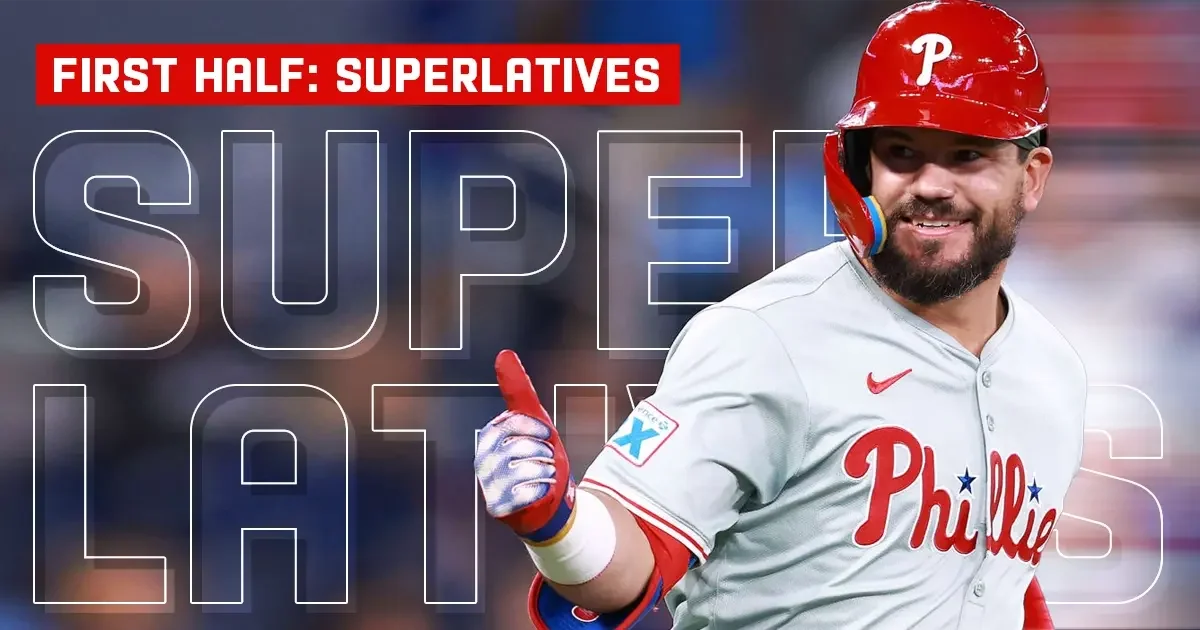
Best Power Bat: Kyle Schwarber
Kyle Schwarber remains one of the most dangerous power hitters in baseball.
The Philadelphia Phillies slugger entered the break batting .254 with 32 home runs, 59 RBI, 57 runs and a .927 OPS across 93 games. His 32 home runs led all MLB hitters, placing him ahead of Yordan Alvarez and Ben Rice.
Schwarber’s value goes beyond his ability to hit the ball over the fence. He also recorded a .367 on-base percentage and drew 59 walks, consistently creating pressure even when pitchers attempted to work around his power.
His first half included 11 home runs in May and eight more in June. He also produced a memorable three-home-run performance against the Mets on June 20, driving in six runs during a 15-3 Phillies victory.
Schwarber was selected to his fourth career All-Star team and finished the first half as one of baseball’s top hitters by OPS. His combination of power, patience and run production makes him BTA Sports’ best power bat of the first half.
Best Contact Bat: Otto Lopez
While Schwarber dominated with power, Otto Lopez separated himself through consistent contact and his ability to put the ball in play.
The Miami Marlins infielder led Major League Baseball with a .334 batting average and 127 hits during the first half. He also recorded 26 doubles, six triples, nine home runs, 45 RBI and 17 stolen bases while producing an .874 OPS.
Lopez’s strikeout numbers make his performance even more impressive. He struck out only 58 times in 380 at-bats, giving him one of the strongest contact profiles among qualified hitters.
His production was remarkably consistent throughout the first half. Lopez hit .330 in April, .339 in May, .340 in June and .340 during his July appearances before the break.
Lopez is not simply collecting empty singles, either. His .505 slugging percentage reflects an ability to drive the ball into the gaps, and his speed adds another dimension once he reaches base.
The Marlins entered the second half with a 52-45 record and remained within striking distance of the NL East lead. Lopez’s emergence as baseball’s leader in batting average and hits has been one of the biggest reasons for their success.
Best Starting Pitcher: Jacob Misiorowski
No starting pitcher was more dominant during the first half than Jacob Misiorowski.
The Milwaukee Brewers right-hander finished the first half with a 10-4 record, 1.62 ERA, 167 strikeouts and a 0.76 WHIP across 111 innings. He led MLB in ERA, strikeouts and WHIP while helping the Brewers produce a 59-37 record, the second-best mark in baseball.
Misiorowski’s ability to overpower hitters has been the foundation of his success. His 13.54 strikeouts per nine innings ranked second among MLB starters, narrowly behind Dylan Cease, while his 6.19 strikeout-to-walk ratio ranked first.
He also led MLB pitchers in several additional categories during the first half, including FIP and hits allowed per nine innings.
Misiorowski has always possessed elite velocity, but improved control and a deeper pitch mix have transformed him from an exciting young arm into a complete starting pitcher. His combination of fastball velocity, swing-and-miss ability and limited baserunners made every start feel like a potential dominant performance.
If he maintains anything close to this level during the second half, Misiorowski will be the clear favorite for the National League Cy Young Award.
Best Reliever: Mason Miller
Late-inning relievers are often unpredictable, but Mason Miller has been nearly untouchable.
The San Diego Padres closer recorded 25 saves, a 0.91 ERA, 72 strikeouts and a 0.78 WHIP across 39.2 innings during the first half. His 25 saves were tied for second in MLB.
Miller allowed only 18 hits and four earned runs while facing 149 batters. Even more impressively, he did not surrender a home run during the entire first half.
His 72 strikeouts meant that more than 48 percent of the batters he faced went down on strikes. Miller combines a fastball that regularly reaches triple digits with a devastating slider that prevents hitters from sitting on velocity.
Whenever San Diego carried a narrow lead into the ninth inning, the game was essentially over. Miller converted each of his first 25 save opportunities and finished the first half as one of the most overpowering relievers baseball has seen in recent years.
Best Rookie: Munetaka Murakami
Munetaka Murakami’s first MLB season has already included historic power, an All-Star appearance and a major role in the White Sox’s surprising playoff push.
The Chicago first baseman hit .232 with 20 home runs, 42 RBI, 45 runs and a .911 OPS during the first half. He also posted a .371 on-base percentage and a .540 slugging percentage.
Murakami’s 20 home runs were tied for 19th among all MLB hitters and ranked second among rookies, trailing only Toronto’s Kazuma Okamoto.
His rookie season became historic before the calendar even reached June. Murakami became the first MLB rookie since 1901 to hit 20 home runs before June and matched Jim Thome for the second-most home runs through the White Sox’s first 55 games. Only Frank Thomas had more.
Murakami missed more than a month because of an injury, making his overall production even more impressive. Despite the absence, he was selected as an American League All-Star and participated in the Home Run Derby.
The strikeouts remain a concern, but his ability to combine elite power with a high walk rate has already made him one of Chicago’s most important hitters. Murakami’s arrival has helped accelerate the White Sox rebuild and placed him firmly in the Rookie of the Year race.
What to Watch During the Second Half
The first half established several fascinating storylines, but none of these awards are guaranteed to hold through September.
The White Sox must prove their young roster can withstand a playoff race. The Mets must decide whether to attempt an unlikely turnaround or begin trading veteran players. Schwarber will try to capture his second consecutive home run title, while Lopez looks to remain atop the MLB batting race.
On the mound, Misiorowski will attempt to complete a Cy Young season and help Milwaukee win the NL Central. Miller will continue protecting narrow San Diego leads, while Murakami looks to regain his early-season rhythm after returning from injury.
There is still plenty of baseball remaining, but these teams and players defined the first half of the 2026 MLB season.